My final bachelor project was oriented on facilitating transformation to a subcategory of vanlife travelers that set out to change themselves by deeply immersing themselves in other cultures and exploring different meaning schemes (Marques et al. 2024)(Ross, 2010). The proposed product solution employed transformative learning theory by Jack Mezirow (1990) to turn impactful experiences into transformative ones. Dubbed "NoMind", it is a reflective VR experience that asks the important questions regarding the vanlifers previous assumptions and employs immersive and gamified elements to deepen the emotional aspect of reflection. It does so to find the underlying, often yet unspoken, cause of any given disorienting dillema and use that cause to trigger transformation through critical reflection. By using a purpose-built virtual environment and gamified journaling practices, the experience facilitates an active, embodied process of meaning-making that moves beyond passive reflection.
VR, gamification and the emotional focus makes NoMind a unique approach to transformative learning theory. It uses this unique position to aim to open new markets through its novelty, specific user population and value proposition.
Link to Report
Link to App Demonstration
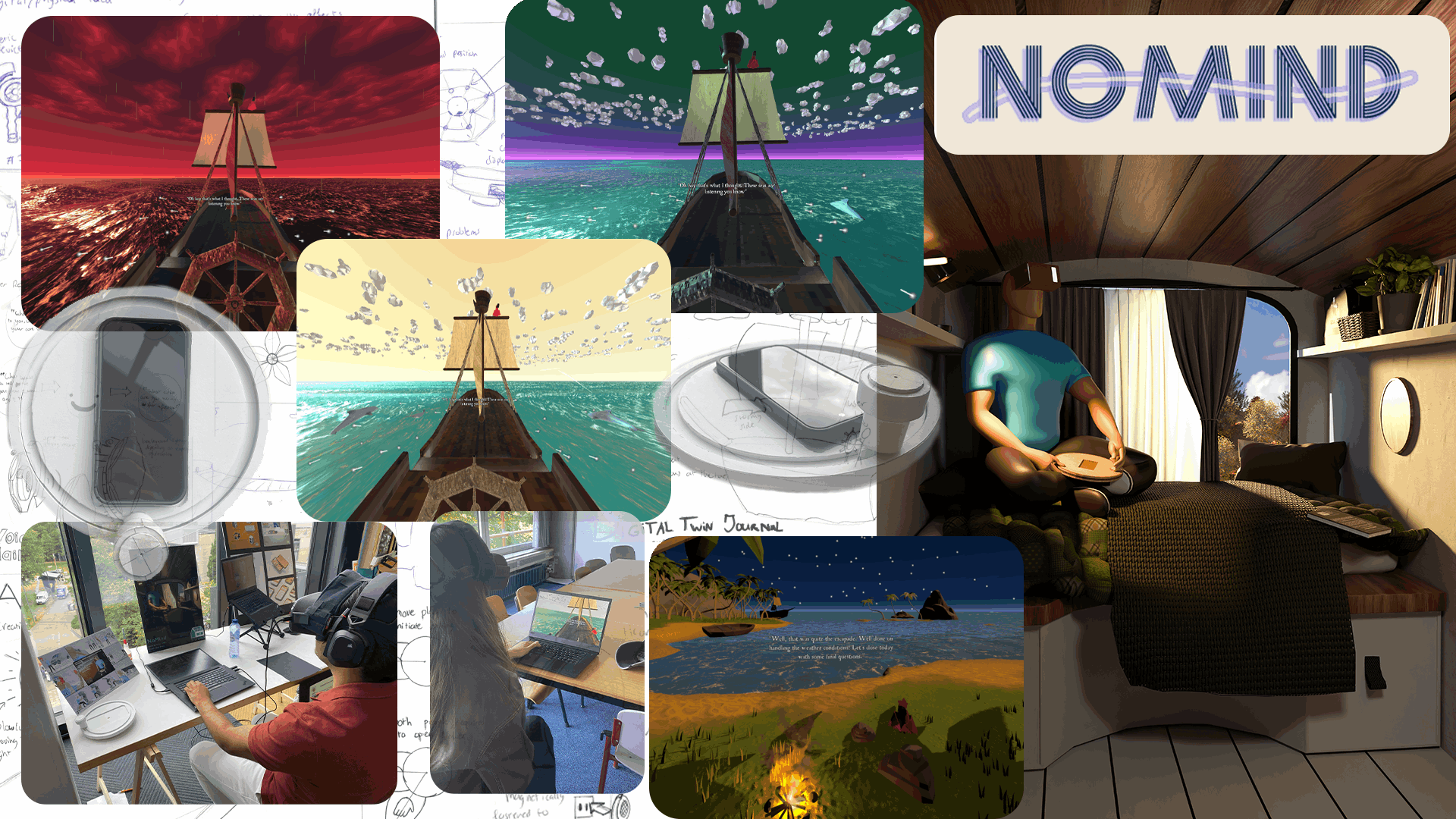
Most notably the project suffered from rigidity and a lack of iteration during the realization phase in favor of immersivity and usability of the VR experience. I believe that my project could've seen a better tailoring to the user and more inherent integration of gamified elements if the project first developed as an MVP to be probed and re-assessed before continuing development. This wasn't seen as critical at the time, but I now think that seeking points of (user)-feedback by approaching development in stages/sprints during realization would've seen the increase of the product/user fit and implementation of long-term gamification to spur intrinsic motivation.
Furthermore, I think a more business-oriented approach from the pivot onwards could've further increased the implementation of gamification and scalability of the concept. By taking a more holistic approach and considering external elements such as the product platform, the product could've addressed flaws in the business model earlier and tailored development going forward. This could've also seen the development of a long-term "transformative track" employing different types of reflection and exploring the need for different reflective experiences.
Entering the major I was used to a solution first, problem later approach from high school. Over the course of my P1 I begun to understand how the specific user problems can be addressed by designing personas and storyboards for people struggling with taking and maintaining food inventory. However it wasn't until P2 that I conducted user tests as a means to directly gauge the effectiveness of a design intervention using live feedback and observation strategies, the setting for the user test concerned a device that would measure their speech distribution as a group.
I now recognize the capacity that user feedback can have on creating an effective design solution, the success criteria lies in a nuanced balance between listening to the user and understanding their deeper needs; ones that they themselves might not even recognize yet. Moreover, after the introduction of the design thinking methodology in the Design Management course. I came to start most projects by identifying and emphasizing with users groups to identify a real (design) problem: U&S has become a vital part of the fuzzy front end and the realization phase of any design process.
Creativity has always been inherent in me. Over the course of my bachelors I've emphasized digital high-fidelity and out of the box ideas. A substantial amount of what I propose and ideate during the fuzzy front end of a design process is outside of the scoping. However, this broad exploration allows space for emergence and creates an atmosphere of liberty taking and discussion within group work; as long as the final concept is communicated and argued for well, I have little objections. In my design processes this often times means an emphasis on proof of concept and aesthetics in order to communicate ideas properly, over say realization of the concept. This goes hand in hand with design to business, which often starts by building upon a proof of concept by adding business canvasses and analyses of markets/similar works to further solidify the validity of the concept. This effective combination of both EAs is now a vital part of my toolkit and identity as a designer. In future work I aspire to apply these affinities to a startup environment and help connect their company's external activities with their external public perception.
Through this natural gravitation towards C&A I've increasingly developed hard skills involving digital visualization and sketching that I've most prominently applied to projects such as TRIBLE (P2), A Walk Home (P3), NoMind (FBP) and the Game Dev electives. Other electives also incorporate C&A through developing posters, videos, stylized canvasses or presentations.
Business & Entrepreneurship was an expertise area I showed very little interest in until the Introduction to Business Design course. The bridge of design to business was quite vague until that point. Being introduced to basic business practices, startup culture and seeing alumni guest lectures piqued an interest for the design to consumer pipeline. I took numerous electives regarding B&E such as: design management, stakeholder perspectives in design and intellectual property rights for new ventures which deepened my belief in design thinking and my understanding of what separates designs built with a business model mind and those that incorporate it as an afterthought.
My USE line--Technology Entrepreneurship--saw the combination of C&A and B&E. Emphasizing and Ideating from the ground up to create a product that would be further assessed for viability using business canvasses, IP assessment and user testing to determine the potential to market. This project sprouted an interest in startups and the desire to become a part of a small design team and have a real say in the direction and work. For future development I envision myself working in such an environment and pursuing applied design-to-consumer knowledge and industry experience for designed products, services or even games.
Technology and Realization is an expertise area I mostly developed in the latter years of my bachelors. Initially, my focus on proof of concepts meant most of my realization work came through technology enabled development of fully digital games or immersive experiences. Physical prototyping was a skill I had developed through woodworking for Engineering Design and P2, however this work was always at the final phase and not explorative. It wasn't until exploratory making that realizing concepts to explore more concepts through interactive and tangible emergent insights became a more integrated part of my repertoire. Prototyping to showcase or gauge interaction became accessible at an early part of the design cycle through creating well-crafted foamcore prototypes.
With this my understanding of realization also shifted from a final-act-only-practice to an early-implementable part of the product design cycle. For example, I used foamcore prototyping in my FBP to test tangible interaction and make design decisions at an early stage of development. The material isn't only limited to exploration however, as the final controller prototype is foamcore based and showcased the interaction and tangibility of the NoMind reflective practice. Lastly, digital T&R has been prevalent all throughout my bachelors but mainly showcased through games (P3, FBP & Game Dev 1&2) as well as the VR video showcasing the TRIBLE concept.
Math, Data and Computing is an expertise area where it is fair to say that my knowledge and experience remain the lowest amongst all. Curriculum standard courses such as data analytics, calculus, physics, creative programming, making sense of sensors elevated skills such as data aggregation and visualization. Having worked mostly with qualitative data for my user test, the need to aggregate data was not as prevalent which resulted in a decrease in algorithms and quantitative data processing from there forwards.
However, these courses improved my efficacy to understand and modify code in Java and Python, which bridged quite nicely into learning a base level of C#. During my FBP I developed my computing skills through applied C# that runs and updates the NoMind experience and aggregates recorded microphone data to an external folder.
I envision the further development of this EA through data-driven design interventions following the SPD master at TU Delft. After all, the power of data in validating design is a resource to be used and one I envision could be of more impact in my work.
Best AI Website Maker